

Our Collaborations
The flagship nature of the Centre allows us to partner with major institutions across the globe. The Centre’s formal international partnerships span Australia, Southeast Asia, Europe and North America.
Collaborators
- Australia
- France
- Japan
- Republic of Korea
- Singapore
- United Kingdom
- United States of America
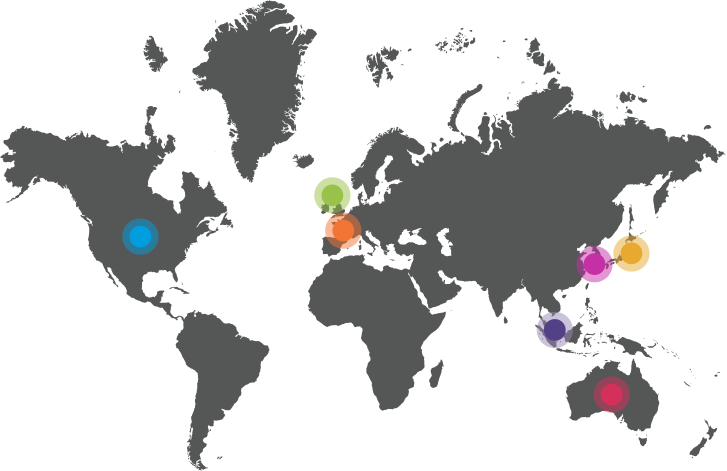
Te Whai Ao — Dodd-Walls is a Centre of Research Excellence with a portfolio spanning photonic, quantum technologies and Māori-led or partnered projects. We pride ourselves on excellent and enduring relationships with researchers abroad. Our Quantum Technologies Aotearoa programme is strongly focused on international partnerships, especially with Singapore, the United Kingdom, Germany, the United States, Japan and the Republic of Korea.
International Partner Institutions and Consortia
Highly regarded international partner institutions include NASA’s Jet Propulsion Laboratory, Varian Systems, Edwards Lifesciences, and the UK’s National Institute of Science and Technology and its National Physical Laboratory. We are strongly represented among international consortia such as SPIE, the international society for optics and photonics, Optica and the global Quantum Economic Development Consortium or QED-C. In New Zealand our door is open to the United States Embassy, the UK High Commission, American Chamber of Commerce, KEA Network, Ministry of Foreign Affairs & Trade and others offering opportunities for our scientists to participate in well-funded projects.
Commercialisation
We’re entrenched in New Zealand’s commercialisation eco system. Along with KiwiNet, Return on Science, and the Commercialisation Partner Network, we’re engaged with the New Zealand Product Accelerator, and university Technology Transfer Offices (Auckland UniServices, Otago Innovation, Massey Ventures, Waikato Link, Wellington UniVentures). With the restructuring of the NZ Science system we have refreshed our links with the new public research organisations: New Zealand Institute for Bioeconomy Science, the New Zealand Institute for Earth Science and the New Zealand Institute for Public Health and Forensic Science. We also work closely with the Malaghan Institute, MacDiarmid Institute and the New Zealand Institute for Minerals to Materials Research (NZIMMR).
The 2025 round of the Catalyst Strategic NZ–Korea Joint Research Partnerships programme. focuses on quantum communication - a rapidly advancing field with transformative potential for secure data and future technologies. This triennial programme supports bilateral research collaborations and is funding three joint projects until 2028.
Researchers from Otago and Auckland Universities are working with their counterparts at Korea’s Advanced Institute of Science and Technology (KAIST) and Kyung Hee University in South Korea on these endeavours.
Te Whai Ao — Dodd-Walls is a member of the Australian and New Zealand Optical Society (ANZOS) holding close relationships with other centres of research excellence and their host universities. These include three Australian Centres of Research Excellence: one in Queensland for quantum biotechnology (QUBIC) , one in Melbourne for optical microcombs, and one in Canberra for transformative meta-optical systems (TMOS).
Our Centre is investigating free space optical communications (FSOC) in an international collaboration with FSOC researchers at the University of Western Australia, the University of South Australia and the Australian National University (ANU). Together the team is developing technologies to improve communications between spacecraft and Earth.
We’re also collaborating with the ANU in a separate project under the Quantum Technologies Aotearoa programme <link> to explore early-stage quantum networking using quantum memories.
We have extensive collaboration with researchers at various CNRS (Centre National de la Recherche Scientifique, French National Research Agency) units in France.
In particular, the international research program known as WALL-IN is the collaboration between CNRS researchers from University of Burgundy (France), led by Dr Julien Fatome, and the photonics laboratory of Associate Professors Stephane Coen, Miro Erkintalo and Stuart Murdoch at the University of Auckland. They’re studying vectorial localized structures in nonlinear Kerr resonators and their applications, including the development of an Ising machine.
As the program finishes at the end of 2025, we are investigating scaling up the collaboration and establishing an IRL (International Research Laboratory) in New Zealand. We’re identifying French researchers who could commit to work in New Zealand for an extended timeframe.
MajuLab is a joint laboratory of the French National Centre for Scientific research (CNRS), Cote d’Azur University (UCA) Sorbonne University (SU), the National University of Singapore (NUS) and Nanjang Technological University (NTU) offering a world class environment for research, both in basic quantum science and in quantum technologies.
New Zealand and Japan enjoy a Strategic International Collaborative Research Program (SICORP). Together with New Zealand’s Ministry of Business, Innovation and Employment , the Japan Science and Technology Agency (JST), supports international joint research into disaster mitigation, response and recovery in three, three-year projects. Areas of mutual interest are:
Advanced materials and nanotechnology applications for disaster resilience.
Research for the development of technology/devices that collect information on the disaster area, or support the rescue of the survivors and response to the disaster.
Hazard and risk modelling of high impact / low probability natural hazards events for example widespread flooding, great earthquakes, large magnitude volcanic eruption.
Comparative research for New Zealand and Japan regarding reconstruction after recent disasters.
We work with Prof. Takao Aoki, of Waseda University, Tokyo. Japan is also a key partner in the Quantum Technologies Aotearoa Programme.
In Singapore, we partner with the Centre for Quantum Technologies (CQT) and with the Centre for Optical Fibre Technology (COFT). As well as research collaboration, we partner with CQT in a number of education outreach activities, including Quantum Shorts, a quantum physics inspired biennial film festival and in evaluation of the efficacy of outreach programmes, while COFT brings us fabrication facilities that are not available in NZ. These include their fibre draw tower.
Singapore is also a key partner in our Quantum Technologies Aotearoa (QTA) programme , formed to ensure New Zealand benefits from the advancement and adoption of quantum. The goal is to foster international collaboration between academia, industry, and governments and to accelerate domestic capability. The joint project with CQT explores entangling atoms to measure magnetic fields.
MajuLab is a joint laboratory of the French National Centre for Scientific research (CNRS), Cote d’Azur University (UCA) Sorbonne University (SU), the National University of Singapore (NUS) and Nanjang Technological University (NTU) offering a world class environment for research, both in basic quantum science and in quantum technologies. We collaborate with NTU on a QTA project to develop an efficient transduction platform to convert quantum signals between frequencies for efficient communications over long distances.
A Research, Science, and Innovation Cooperation Arrangement, was signed with the UK in 2022 to deepen the integration and alignment of the countries’ science systems. There’s an agreed work programme with the following priority areas:
Quantum technologies
Oceans and climate change
Aerospace technologies
Agritech
Bioengineering
Accordingly, the UK is one of five priority countries in the Centre’s Quantum Technologies Aotearoa programme. We partner with the UK Quantum Technology Hub in Computing and Simulation.
New Zealand and the UK are both associated with Horizon Europe and have agreed to identify opportunities for our researchers to collaborate within Pillar II of this programme.
Together with the University of Warwick we’re improving New Zealand’s space situational awareness (SSA) capability, using an optical telescope. SSA refers to the location, trajectory, and status of natural and artificial objects in Earth's orbit.
The National Physical Laboratory (NPL) is a world-leading centre of excellence that provides cutting-edge measurement science, engineering and technology to underpin prosperity and quality of life in the UK. An agreement between our member organisation, the Measurements Standards Laboratory and NPL is supporting a massive seafloor cable-based sensing project expected to enhance seismic and tsunami sensing. Greater understanding of seafloor dynamics delivered via our Quantum Technologies Aotearoa programme is expected to help develop a cost-effective, scalable approach to ocean monitoring that could contribute to disaster preparedness efforts.
Researchers from the US National Institute of Standards and Technology (NIST) are exploring the quantum optics of chip scale lasers in collaboration with our researchers under the Quantum Technologies Aotearoa (QTA) programme. The NIST also has a Quantum Economic Development Consortium or QED-C.
The QTA programme includes another US/NZ project, this time with the Joint Quantum Institute (USA) and the Quantum Materials Centre at the University of Maryland to research devices for quantum computing applications.
We also work with NIST in Colorado, which has the necessary infrastructure to demonstrate a microwave → optical → microwave quantum network for the QTA transduction project. NIST’s experience in optomechanical transduction techniques ensures the technology we develop is suitable for future use in quantum communications networks.
Together with a researcher from NASA’s Jet Propulsion Laboratory we’re investigating a scheme to detect high-frequency microwave radiation and thermal microwave radiation using nonlinear optics. A photonic radiometer would target GHz/THz frequencies for tracking atmospheric gases like ozone.
Te Whai Ao — Dodd-Walls Centre has established a New Zealand node of the Global Environmental Measurement and Monitoring (GEMM) Network. The GEMM Network is an initiative of OPTICA and the American Geophysical Union. It currently has nodes in the United States, Canada and Scotland. The aim of the GEMM Network is to create better sensors and measurement networks so that climate modellers, Governments and other agencies have the information they need to inform policy decisions.

The Dodd-Walls Centre research focus is photonics, the generation, transmission, and manipulation of light, and the study of matter and energy at the quantum level.